
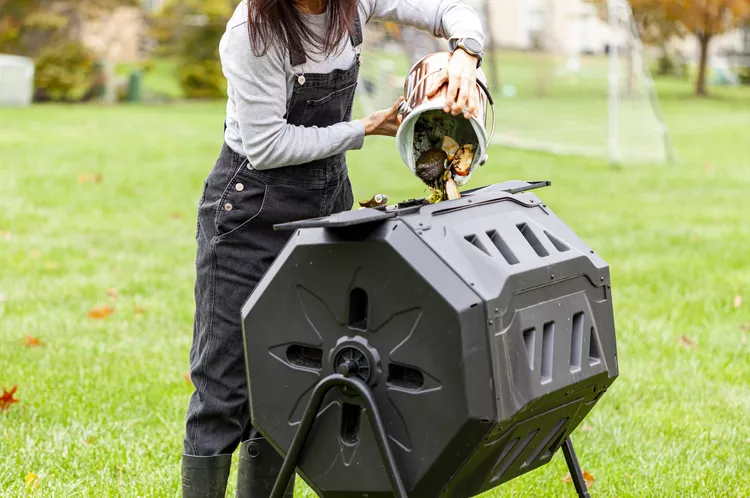
When you know how to use a compost tumbler correctly, you can make compost faster than with stationary compost bins. Compost bins and tumblers work in the same way. They allow microorganisms to transform kitchen scraps and garden wastes into a nutrient-rich soil amendment. They require both "brown matter" (high in carbon), such as straw, shredded paper, sawdust, and pine needles, and "green matter" (high in nitrogen), which includes vegetable and fruit waste from the kitchen, fresh seed-free weeds, and fresh grass clippings. The ideal ratio is about three to four parts brown to one part green. If you add too much green material, composting slows down, resulting in a soggy mess. You may find that a paper shredder is just the ticket for adding lots of brown matter. If you used to shred paper for security; now, shred it to feed your compost.
Compost Tumbler vs. Compost Bin
A few major differences exist between a compost tumbler and compost bins that don't move. The biggest benefit of a compost tumbler is how easy it is to turn your compost. Turning helps speed up composting by adding oxygen—another requirement for those hardworking microorganisms—to the mix. Turning compost in a bin is strenuous work, usually done with a garden fork or shovel. It can take a lot of time and result in a tired or sore back if you get too carried away.
In contrast, a compost tumbler is built to be turned. The drum sits on an axis—either vertically or horizontally—with handles that allow you to turn the drum with a lot less effort. Turning it a couple of times a week keeps the process moving along. That said, the fuller the drum, the harder it becomes to turn. But it's still a breeze compared to turning compost in a bin with a garden fork, and it literally only takes a minute.
Compared to open compost bin systems, compost tumblers are closed systems that offer several advantages. While tumblers have ventilation holes that allow air in and excess moisture out, these are small enough to keep out unwanted critters. In general, compost tumblers are easier to keep tidy and have a small footprint, which makes them suitable for smaller suburban/urban yards.
Types of Compost Tumblers
While most tumblers sit on an axis or within a frame, some sit on the ground where they can be rolled. The drum of a tumbler on an axis may be oriented vertically or horizontally. Compost tumblers come in various sizes, so you'll want to consider how much kitchen waste you generate and the space available when making your choice.
The most important feature to consider in a compost tumbler is the benefit of a dual chamber. If you have a single-chamber compost tumbler, you must wait once that chamber is full for the compost in it to mature before adding more scraps. This takes about two months, and unless you have a second tumbler, a lot of kitchen scraps will be sent to the landfill.
If you have a dual-chambered tumbler, you can start the process again in the second chamber as soon as you’ve filled the first. Often, the time it takes to fill the second chamber is about the same time it takes for the first chamber to become usable.
How to Use a Compost Tumbler
Place your tumbler in a sunny location in your yard. This helps add heat to the drum to speed up decomposition. Add brown and green waste material you want to compost. You can add this material to your tumbling composter all at once or over time. Put in kitchen waste as you generate it, adding sufficient shredded paper to keep it in balance. Cut up the kitchen waste into small pieces if you wish to speed up the process.
Turn the tumbler every three to five days. If it seems dry, pour in a bit of water. When the tumbler is about three-quarters full, stop adding new material but keep turning it regularly. Depending on the temperature, your compost should be finished in six to eight weeks (maybe a little longer in the winter).
How you remove the finished compost depends on the design of your tumbler. For some models, you can roll a wheelbarrow directly under the opening and turn it so the compost spills out. Or you can use a narrow shovel to scoop out the finished compost. If you find a few bits that are not entirely composted, just leave them; they’ll finish breaking down in the next cycle. Using a compost sifter will help remove larger pieces that need more time. It’s also a good idea to leave some of the finished compost in the chamber for the next batch to be sure you have a starter supply of good microbes.