
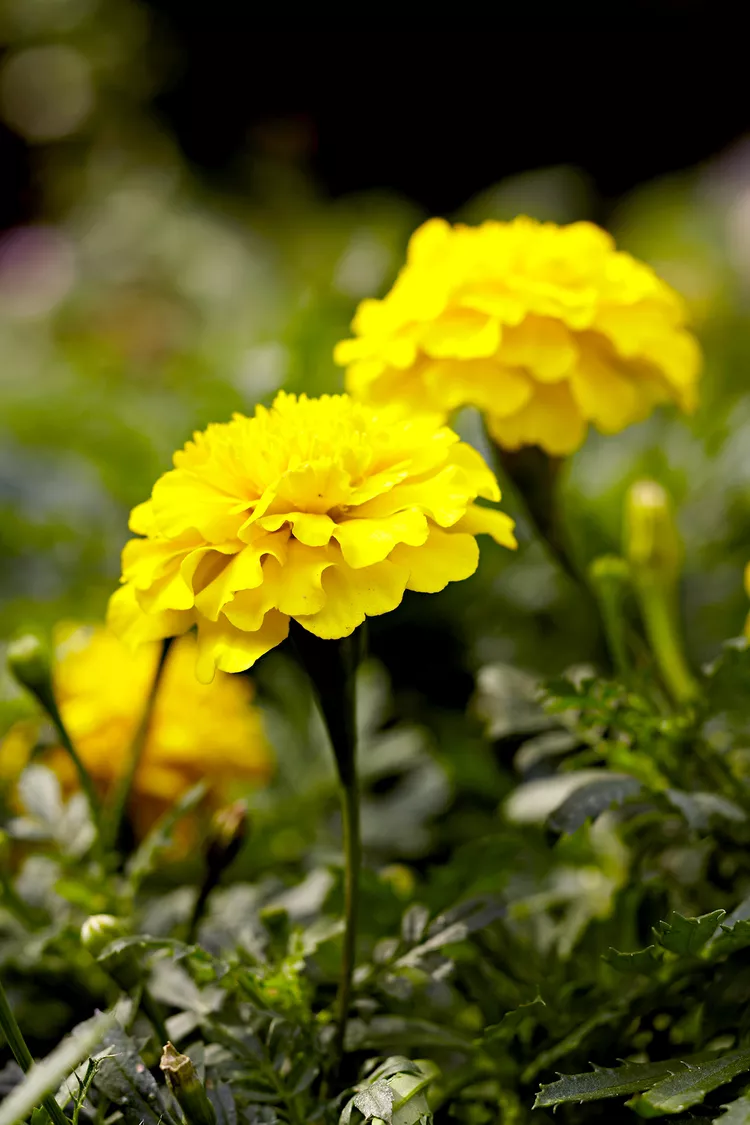
Are marigolds perennials or annuals? The answer is both. While most people grow them as annuals, a few types are perennials. Marigolds are in the genus Tagetes, from the sunflower family, and are native to the Americas. With 49 species, there are sure to be some you haven’t tried yet, and breeders are coming up with new varieties every year.
The commonly planted French marigolds and African marigolds are annuals—they sprout, grow, flower, and die, all in the same year—but that doesn’t mean they won’t come back. Marigolds frequently self-seed, meaning their seed drops, overwinters, and germinates in the spring without any help from the gardener. Depending on your garden plans and how vigorously the marigolds reseed, that can be great or frustrating.
Annual Marigolds
The two most commonly planted types, French and African marigolds, are annuals. They bloom from summer until frost. In areas without cold winters, they grow old and die. The smaller, delicately flowered signet marigolds are also annuals.
Many annual marigolds self-seed and come back the following year. If you want your marigolds to self-seed, stop deadheading them a month before the frost date in your area and let the flowers develop into seed heads. They will eventually burst open and drop the seeds. You can also collect the seeds and plant them yourself.
Some hybrid marigolds are sterile and won’t produce viable seeds. If they do, the offspring likely won’t resemble the parent plant. Choose open-pollinated varieties if you want marigolds to self-seed.
Open-pollinated marigolds are sometimes identified with an OP on the package or an indication they are an heirloom variety. Hybrids might be labeled as hybrids or have an (F1) on the package.
Perennial Marigolds
While most marigolds are annuals, a few are perennial shrubs native to Mexico and the American Southwest. You may need to order these from an online vendor as they are not often found at garden centers.
- Mexican marigold (T. lemmonii) is a perennial shrub hardy in USDA Zones 8 to 11. It can grow quite large, up to 6 feet tall, and is covered in small yellow blooms that draw pollinators. Other common names include Copper Canyon daisy and Mexican bush marigold.
- Mountain marigold (T. palmeri) is a semi-evergreen shrub with delicate, aromatic foliage and small golden blossoms. It reaches about 3 feet tall and is hardy in Zones 8-10.
- Mexican mint marigold (T. lucida) is a more petite perennial, reaching 1-3 feet tall. Also called Mexican tarragon, it is often used in cooking and for teas. These smaller shrubs are hardy in Zones 8-10.
How to Plant Marigold Seeds
Marigold seeds can be purchased by the packet—or the pound if you want a lot of marigolds. While common varieties are found at big box stores, head online to find unique cultivars.
Marigold seeds can be directly sown in the ground or started indoors and transplanted. They enjoy full sun but can tolerate some partial shade, especially in the afternoon in hot climates.
Starting Marigold Seeds Indoors
Marigolds should be started indoors about four weeks before the last frost in your area. Follow these steps:
- Prepare the planting mix by watering it an hour before use and allowing it to absorb. Pre-watering the mix eliminates attempting to water after planting and disturbing the tiny seeds.
- Sow seeds ¼ inch deep in flats or cells, and lightly cover them with premoistened soil mix. Cover the tray with plastic wrap or a humidity dome until about 75% of the seeds have sprouted to prevent them from drying out. Marigold seeds should germinate in about 6-10 days at room temperature.
- Keep the soil lightly moist, not wet or soggy. Marigolds and other seedlings are subject to a fungal problem called damping off, which occurs when too much moisture is in the soil mix.
Sowing Marigold Seeds in the Garden
- Prepare the area by removing weeds and working in a layer of compost.
- Smooth the bed and plant the seeds ¼ inch deep, about an inch apart. You can thin them later.
- Water gently, and test the soil with your finger to ensure it is moist several inches down. If you are planting a large area for mass effect, scatter the seeds, use a rake to cover them lightly, and then water them.
Care Tips for Marigolds
Marigolds are not often bothered by insects and don’t need much help from gardeners. To keep them looking their best, deadhead the flowers throughout the growing season and pinch the plants when young to force a bushy, branching habit. Mulch underneath them to keep the weeds down.
Marigolds prefer to dry out a little between waterings and, if planted in the ground, are somewhat drought-tolerant once established. Marigolds grown in containers need weekly or more frequent watering.